
Diese Seite ist auf Englisch: sie beschreibt die API, die Englisch spricht, und ihre Nutzungsbedingungen gibt es nur in einer Sprache, damit es nur eine gültige Fassung gibt.
Developers
The hubs, networks, centres, circles, people and IDG Ambassadors on this site are available as JSON, so other IDG community sites, apps and dashboards can reuse the data instead of scraping the map. Read-only, one key per consumer, no cost.
What you get
Six endpoints, each returning the same public records the site shows, and nothing an anonymous visitor could not already read, plus updated_at for incremental syncs:
/api/v1/hubs· Hubs: name, location and coordinates, description, website, the hub's own shared email, founding date, theme, geography, meeting frequency, contacts with email./api/v1/networks· Networks: the same, with a scope instead of a location./api/v1/centres· Centres: host organisation type, location and coordinates, description, website, the centre's own shared email, launch date, contacts with email./api/v1/circles· Circles: name, theme, description, language, contacts without email, and which contact represents the circle./api/v1/people· People listed in the directory: name, place and coordinates, bio, portrait, links and page address; an email only for a contact of a hub, network or centre, as on the site. Nobody unlisted is ever in it./api/v1/ambassadors· IDG Ambassadors who have claimed their profile and are listed: the same personal fields, and since when.
Every response says where the data comes from, who serves it and under what licence. Hubs and networks were last refreshed from the Foundation’s directory on 1 October 2026, centres on 1 October 2026. Circles, people and ambassadors are IDG Earth’s own records, kept by the people in them.
curl -H "Authorization: Bearer idg_live_…" https://idg.earth/api/v1/hubs

{
  "count": 12,
  "last_modified": "2026-09-05T10:00:00Z",
  "source":   { "name": "Inner Development Goals Foundation, hubs and networks directory", "url": "…", "retrieved": "2026-10-01" },
  "provider": { "name": "IDG Earth", "operator": "IDG Inner Development Goals AB (svb)", "role": "broker", … },
  "licence":  { "holder": "Inner Development Goals Foundation", "terms": "…" },
  "hubs": [ … ]
}
The contract is an OpenAPI 3.1 document: openapi.json, browsable at /api-docs.html. Every response carries ETag and Last-Modified; send If-None-Match to get a bodyless 304 when nothing changed, or ?modified_since=2026-09-01 to fetch only what changed. /v1 is stable: additive changes ship without a bump, breaking changes go under /v2.
The numbers, with no key
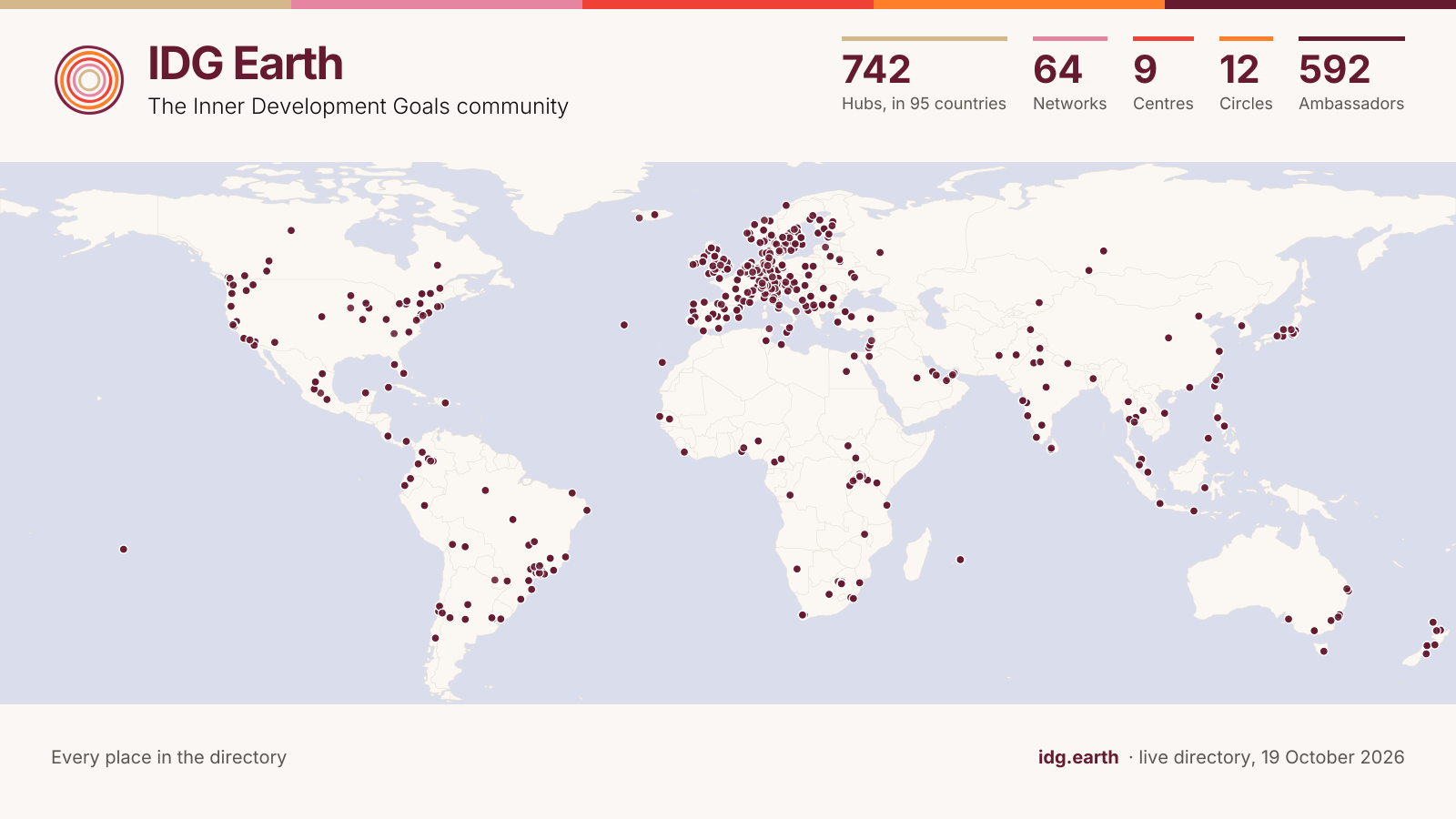
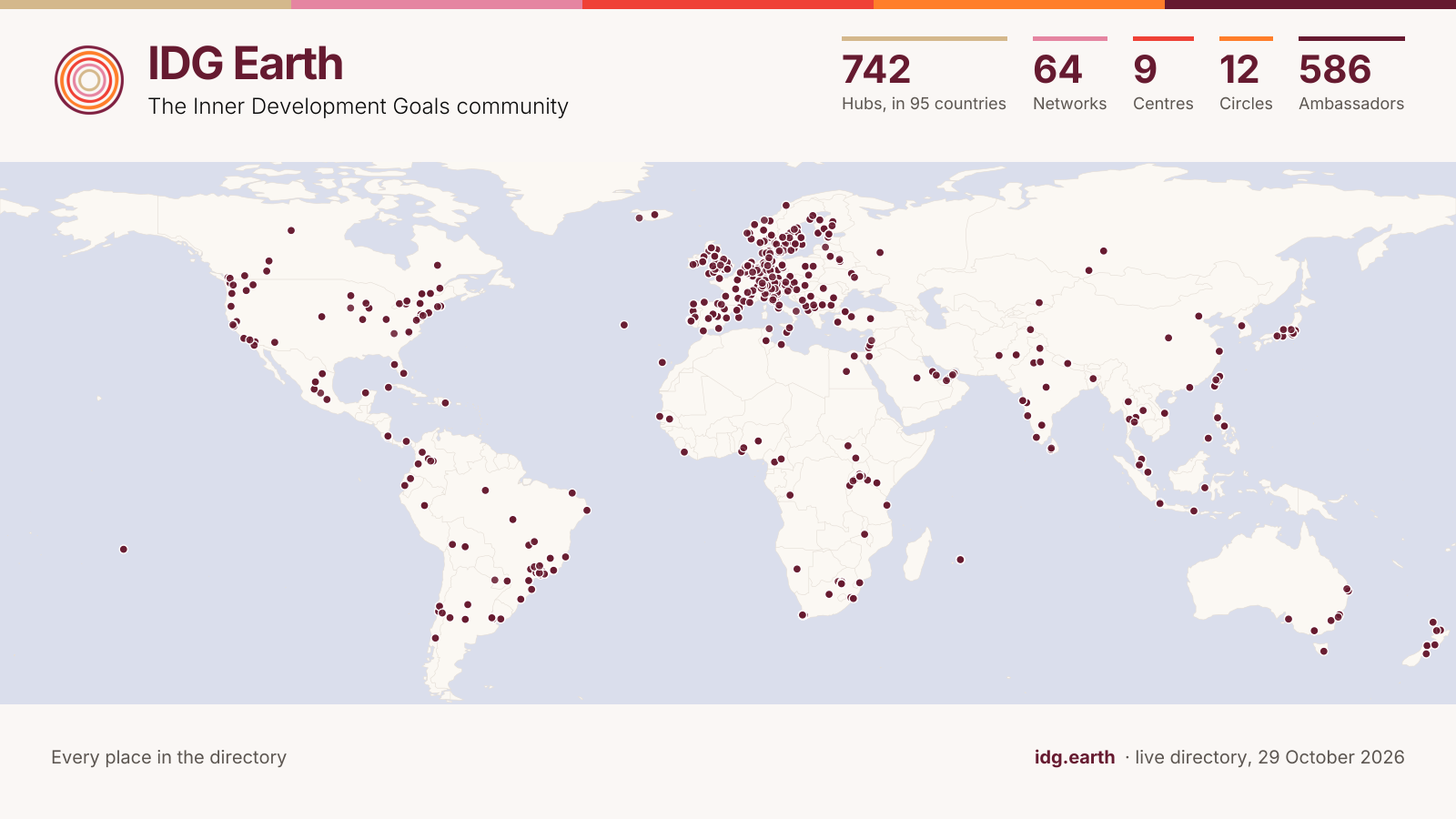
/api/v1/numbers answers without a key: how many hubs and in how many countries, networks, centres, circles and IDG Ambassadors, counted from what the site shows, with the dates above. It carries counts only, never a record, so slides, dashboards and other sites can quote the community and stay right.
The same numbers on a world map, every public hub and centre, and everyone in the directory as an unnamed dot at their city: /map.png, drawn when it is asked for. Download the latest.
Restricted datasets
Two datasets go beyond what the site shows, and are given only to a site of the IDG Earth family, for stated purposes: /api/v1/contacts (contact-addresses: the email of every contact of an active hub, network, centre or circle) and /api/v1/merges (merges: which person record was kept when two became one, ids only).
They may be used to tell an entity’s contacts about events that concern it, and to keep records joined when people are merged. They are not a mailing list, are not stored beyond the moment of sending, and are not shared onward. Every read is logged. Their answers cannot be read from a page in a browser and are kept by no cache. A key with them always has a lifetime chosen when they were given.
A third, /api/v1/people/lookup (people-lookup), finds any person in the directory, listed or not, so a site of the family can connect them to something of its own, such as a circle or an event, without keeping a profile of its own. It searches and never lists: ?q= with at least three letters, found anywhere in the name, or an exact email, returns at most 20 people; ?id= refreshes up to 50 already connected. Each person comes with their id, name, country, photo and whether IDG Earth lists them; someone who is not listed is not shown to the public by the site that found them. A key may make 600 lookups an hour, and every lookup is logged.
Getting a key
Email echo@idg.earth with your name, organisation and what you are building. You get a key that looks like idg_live_…, shown once. Send it as Authorization: Bearer <key> or in an x-api-key header.
A key names what it may read, so say which of the endpoints above you need. Asking for one the key does not list is answered 403 with its name in dataset; we can add it to the same key. A key lives 30, 90 or 180 days, a year, or without end, as agreed when it is issued. Its owner is mailed two weeks and three days before it expires; an expired key is answered 401 with reason: "expired", an unknown or revoked one with reason: "invalid". Renewing never changes the key itself.
Keys exist so we know who is using the data, can tell you before a breaking change, and can switch a key off if it is misused. Nothing else is tracked beyond when a key was last used.
Terms
- The data originates from the Inner Development Goals Foundation’s public directory of hubs and networks and the IDG Centres programme. IDG Earth transcribes it and is a broker, not the source.
- IDG Earth is run by IDG Inner Development Goals AB (svb). Do not present this data as the Foundation’s endorsement of your service.
- The IDG name, framework and logo belong to the Foundation and are used under its Public Licenses for Use of Materials. Using the data does not grant you any right to the brand.
- Contact details are for reaching hubs, networks and centres, not for bulk mailing or building lists. People’s and ambassadors’ profiles are theirs: show them as they are, link to their page, and drop anyone who is no longer in the list. A key that is misused is revoked.
- The API comes as is, without uptime or continuity guarantees. If the Foundation or a hub asks for a field to be withdrawn, it will be.